When it comes to office flooring, it’s not just about selecting the most preferred carpet. How a carpet is supplied and installed can play a part in future maintenance, repairs, maintenance, ease of furniture move in and out of the carpet, and even the ease of modifying the office later on.
Once you have narrowed your selection down to two choices, you’re probably left with carpet tiles or broadloom carpet.
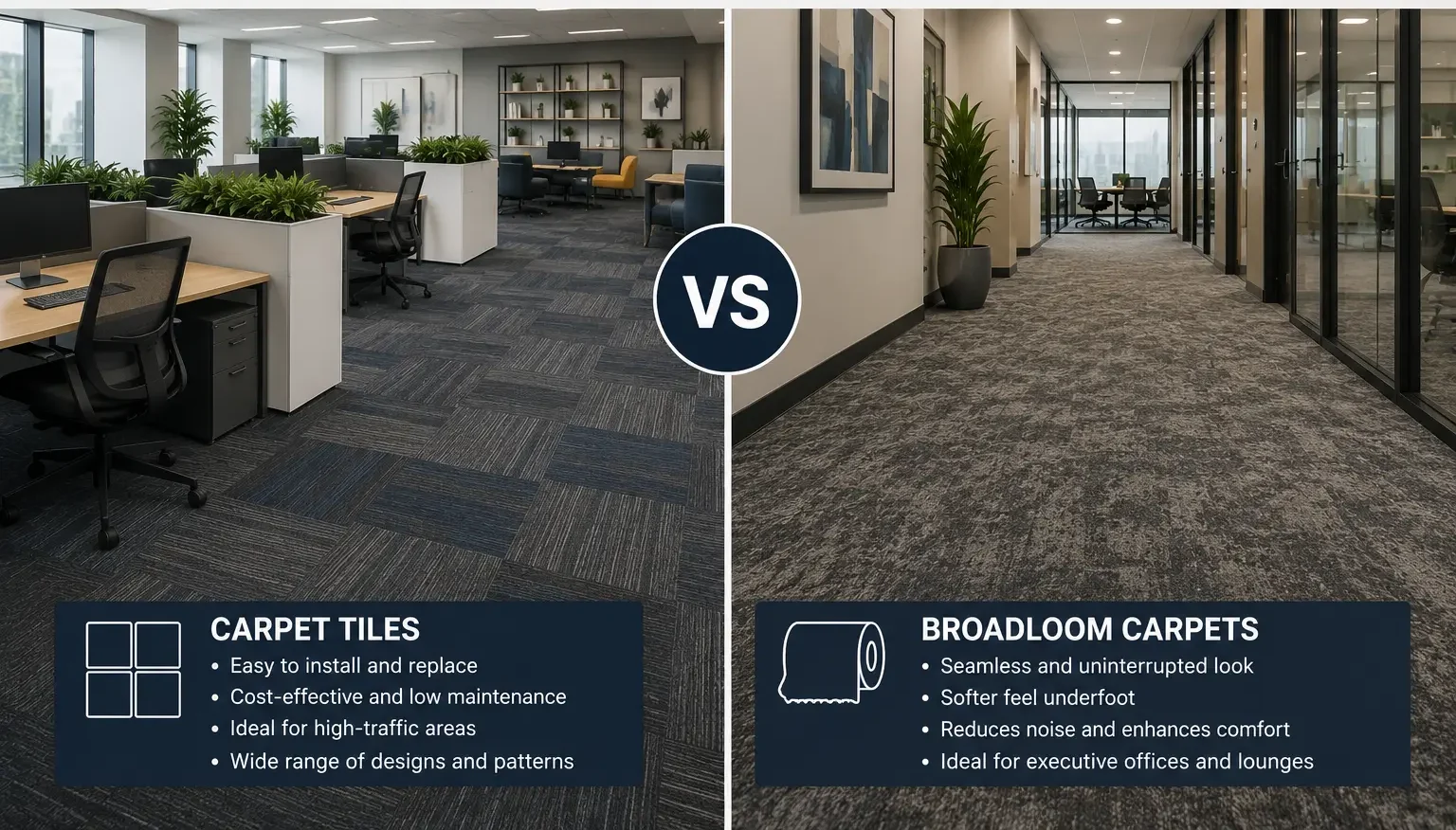
Carpet tiles are blocks of carpet that are typically laid one-by-one on the floor. The broadloom carpet is used as large rolls to cover the entire floor area to provide a seamless look.
Both can be very effective in an office environment. This is a decision that will vary based on your home floor plan, traffic, maintenance considerations, design aesthetic and how often you expect to move furniture. Let’s compare the two office carpet options in Dubai.
What Is the Difference Between Carpet Tiles and Broadloom Carpet?
The simplest difference is how the carpet reaches your floor.
Carpet tiles are individual modular pieces. If one section becomes badly stained or damaged, that particular tile can potentially be removed and replaced without disturbing the rest of the floor.
Broadloom carpet is supplied in wide rolls and installed across a larger area. It creates a more continuous appearance, with fewer visible joins when properly fitted.
Neither option is automatically better.
Think of carpet tiles as a practical choice for businesses that value flexibility. Think of broadloom as a strong option when a continuous, tailored carpet finish is the priority.
Carpet Tiles: Where They Make Sense

Carpet tiles are particularly useful in offices where the floor has to cope with changing conditions.
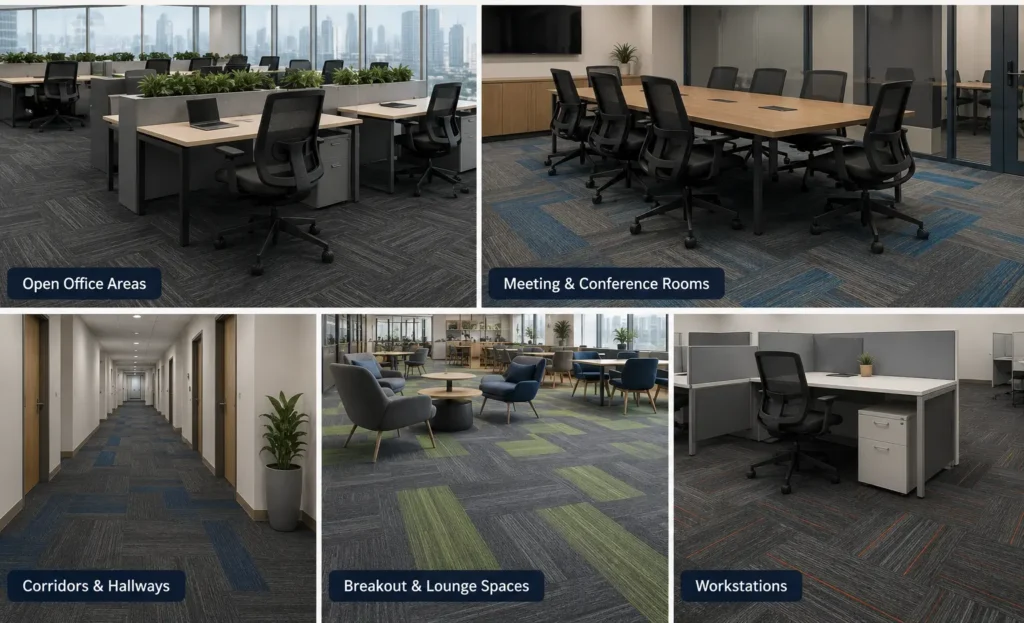
An open-plan workplace, for example, may have desks, meeting areas, walkways, breakout zones and reception spaces all sharing the same floor. Some sections will naturally receive more traffic than others.
With modular tiles, maintenance can be more targeted.
Easier Local Replacement
This is one of the biggest practical advantages of carpet tiles.
Suppose a chair damages a small section of carpet or a high-traffic walkway becomes visibly worn. With a suitable replacement tile available, you may only need to address the affected area rather than remove a large section of carpet.
That can be especially useful for businesses that want to keep disruption to a minimum.
Good for Offices That Change
Companies move departments, add workstations and redesign interiors. Carpet tiles can accommodate these changes more easily because the flooring is already divided into manageable sections.
They can also be installed in different directions or patterns, depending on the product and design.
Design Flexibility
Modular carpet does not have to look plain or repetitive.
Businesses can combine colours, textures and patterns to define zones within an office. A darker path can visually separate circulation areas, while a different tone can identify meeting or collaboration spaces.
This is useful when you want the floor to contribute to workplace wayfinding without adding physical partitions.
Broadloom Carpet: Where It Makes Sense
Broadloom carpets remains a popular choice when a business wants a more unified appearance.
It is particularly suited to spaces where the flooring design needs to flow continuously from one area to another.
A More Continuous Appearance
One of the main attractions of broadloom carpet is the uninterrupted visual effect.
When correctly measured and installed, the carpet can create a consistent surface across a large office area. This can work particularly well in executive offices, conference rooms, reception areas and spaces where presentation matters.
More Freedom With Large-Scale Patterns
Because broadloom is supplied in rolls, it can work well with certain larger patterns and designs that need to flow across a room.
However, patterned carpet requires careful planning. The installer needs to consider pattern alignment, room dimensions, joins and waste before installation.
Comfortable Underfoot

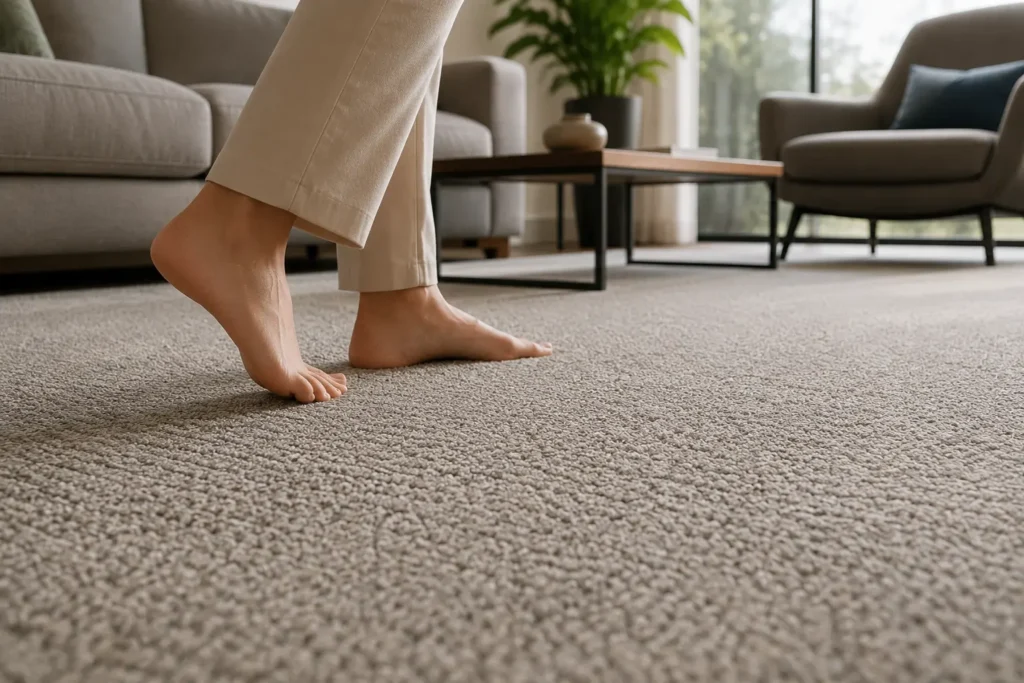
Broadloom carpets can provide the same general benefits associated with quality commercial carpet, including a softer surface underfoot and a warmer feel than hard flooring.
The final performance depends heavily on the carpet construction, fibre, pile, backing, underlay where applicable and installation method.
Carpet Tiles vs Broadloom: Side-by-Side Comparison
| Factor | Carpet Tiles | Broadloom Carpet |
| Installation | Installed in individual sections | Installed from large rolls |
| Local replacement | Generally easier | Can require cutting and patching |
| Design flexibility | Excellent for modular patterns | Excellent for continuous designs |
| Appearance | May show tile lines depending on design | More continuous visual effect |
| Office changes | Very practical | Less flexible once installed |
| Damaged area | Individual tile may be replaced | Damaged section may need repair |
| Waste | Can be efficient for some layouts | Depends heavily on room dimensions |
| Large open areas | Very suitable | Very suitable |
| Executive spaces | Suitable | Often preferred for continuous finish |
| Maintenance strategy | Highly targeted | More traditional |
The important point is that these are not absolute rules. A high-quality carpet tile can look extremely polished, while a well-installed broadloom carpet can be highly practical.
The specification matters as much as the format.
Which Is Better for High-Traffic Offices?
This is where many businesses make the wrong comparison.
Instead of asking only, “Are carpet tiles more durable?” or “Is broadloom stronger?”, look at the carpet construction and the traffic pattern.
A busy reception desk, corridor or area around lifts may experience much more foot traffic than a private office.
For these areas, consider:
- Fibre type
- Pile construction
- Pile density
- Backing
- Stain resistance
- Cleaning requirements
- Expected traffic
- Quality of installation
- Availability of replacement material
Carpet tiles have a practical advantage when wear is concentrated in particular locations because individual sections can be replaced.
Broadloom, meanwhile, can perform very well across busy commercial spaces when the correct commercial-grade carpet is selected and maintained properly.
Which Is Easier to Maintain?
Neither flooring type is maintenance-free.
Regular vacuuming, prompt treatment of spills and periodic professional cleaning are important for both.
The difference appears when something goes wrong.
Imagine coffee is spilled repeatedly near a pantry entrance. With carpet tiles, replacing the affected sections may be relatively straightforward if matching stock is available.
With broadloom, a damaged area can still be repaired or patched, but the work may be more involved. A good repair depends on having a suitable matching piece and an installer who can make the repair blend into the surrounding carpet.
This is one reason businesses should think about future maintenance before installation, not after the first problem appears.
What About Installation?
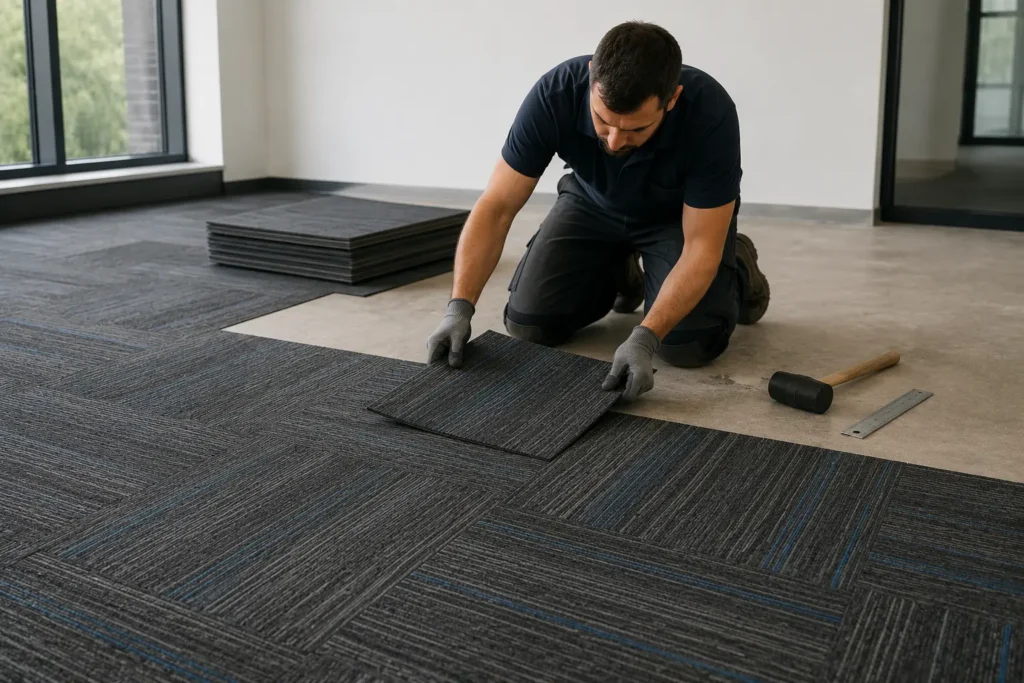
Installation quality can make or break the final result.
For carpet tiles, the floor needs to be properly prepared and the tiles correctly positioned and secured. Tile direction and pattern alignment also need attention.
For broadloom, accurate measurement becomes particularly important because the installer has to account for joins, room dimensions, doorways, columns, corners and pattern matching where applicable.
A poorly planned broadloom installation can create unnecessary waste. Poorly aligned carpet tiles can make an otherwise good product look untidy.
For either option, the existing floor should be assessed before installation.
Which Option Is Better for Dubai Offices?
Dubai businesses have a few practical considerations that should be included in the decision.
Many offices operate in commercial buildings where work needs to continue around the installation. Others occupy leased spaces where future layout changes are possible.
In these situations, carpet tiles can be attractive because they make localized maintenance and future changes easier to manage.
For a more permanent office fit-out, particularly one where the design calls for a consistent wall-to-wall appearance, broadloom carpet may make more sense.
The right answer also depends on the size and shape of the space.
A straightforward rectangular office may suit either system. A floor with numerous small rooms, irregular corners, access points and changing work zones may benefit from the flexibility of modular flooring.
Carpet Tiles or Broadloom for Open-Plan Offices?
For an open-plan office, start by looking at how people actually use the floor.
Map out:
- Main walking routes
- Desk areas
- Meeting spaces
- Reception and entrance zones
- Pantry or refreshment areas
- Printer and storage areas
- High-use collaboration spaces
If traffic is concentrated in certain routes, carpet tiles give you a useful maintenance advantage.
They also allow different tile designs or colours to be used for visual zoning without physically separating the workspace.
Broadloom can be a better fit if the main objective is a uniform, uninterrupted appearance across the entire open-plan floor.
What About Office Furniture and Rolling Chairs?
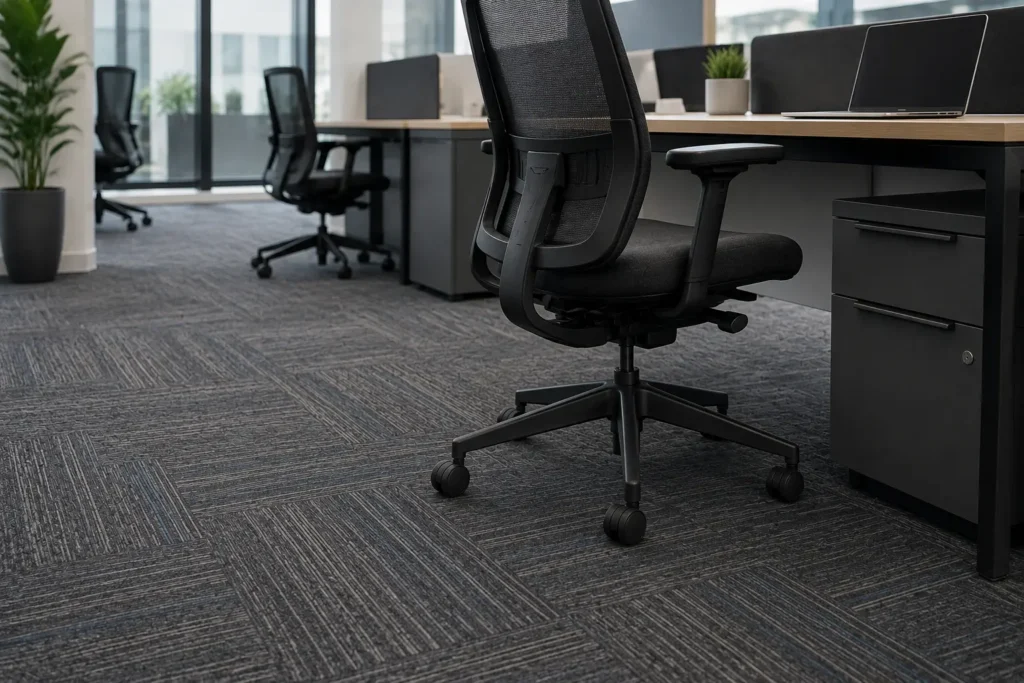
Desks, task chairs, cabinets and meeting tables can create repeated pressure and traffic in specific locations. The carpet specification should therefore suit the way the office is furnished.
For workplaces with large numbers of rolling chairs, pay attention to the carpet pile and construction rather than judging the product by appearance alone.
The backing and installation also matter. A carpet that looks excellent in a sample can behave differently when installed across a large workspace under daily commercial use.
Which Is More Cost-Effective?
It is tempting to compare the price per square metre and immediately choose the cheaper option.
That is not always the best way to calculate the real cost.
Consider the full project:
- Carpet material
- Installation
- Floor preparation
- Underlay, if required
- Cutting and wastage
- Future repairs
- Replacement material
- Cleaning
- Office downtime
- Potential future layout changes
Carpet tiles may offer better long-term flexibility in an office where localized replacement is likely.
Broadloom may provide good value where the floor plan is straightforward and the business wants a continuous finish with a long-term installation plan.
So instead of asking “Which is cheaper?”, ask:
“Which flooring format will cost less to own and manage over the life of the office?”
That is a much more useful comparison.
When Should Your Business Choose Carpet Tiles?
Carpet tiles are worth considering if:
- Your office layout may change in the future.
- Some areas receive significantly more traffic than others.
- You want easier localized replacement.
- You like modular patterns and colour zoning.
- You want to reduce disruption during future repairs.
- The office contains many separate work zones.
- Maintenance flexibility is a high priority.
They are particularly practical for modern workplaces where furniture and departments may be rearranged over time.
When Should Your Business Choose Broadloom Carpet?
Broadloom can be the better choice when:
- You want a continuous wall-to-wall appearance.
- The office layout is relatively permanent.
- You are creating a formal or executive environment.
- A large-scale carpet pattern is part of the design.
- You want the floor to have a consistent visual flow.
- The installation area has a straightforward layout.
Reception areas, boardrooms and executive spaces can benefit from this type of finish when the design calls for a more traditional wall-to-wall carpet appearance.
Don’t Forget the Carpet Backing
It is easy to spend most of your time choosing colours and patterns and overlook what is underneath.
Backing affects how the carpet behaves after installation. Depending on the product, backing can contribute to stability, dimensional performance and installation requirements.
For office flooring, also consider whether an underlay is appropriate for the specific carpet and floor construction.
For example, underlay products can be selected according to factors such as floor type, thickness and acoustic requirements.
The right specification depends on the complete flooring system rather than the carpet surface alone.
Can You Combine Carpet Tiles and Broadloom?
Yes.
There is no rule saying an entire commercial property has to use one carpet format.
For example, a business could use broadloom in a formal meeting room or executive area and carpet tiles in an open-plan workspace.
Different flooring formats can serve different practical requirements while still being coordinated through colour, texture or pattern.
This can be a sensible approach for larger offices where each area has a different function.
Common Mistakes Businesses Make
Choosing Based Only on Appearance
A beautiful carpet sample does not automatically make it suitable for heavy office traffic.
Look at construction and maintenance requirements as well.
Ignoring Future Repairs
Ask what happens if a small section becomes damaged three years after installation.
The answer may influence whether modular or broadloom carpet makes more sense.
Buying Without Measuring Properly
Office layouts contain doors, columns, furniture and unusual corners. Accurate measurement helps determine the actual material requirement and installation approach.
Choosing a Carpet Without Considering Traffic
A private office and a busy reception area do not necessarily need the same carpet specification.
Treating Installation as an Afterthought
Even a good carpet can look poor when joins, edges, alignment or floor preparation are handled badly.
Final Verdict: Which One Should Your Business Choose?
There is no universal winner between carpet tiles and broadloom carpets.
Choose carpet tiles when flexibility, targeted maintenance and future office changes matter most.
Choose broadloom when a continuous appearance, permanent layout and traditional wall-to-wall finish are higher priorities.
And if your office has different requirements in different areas, consider using both.
The best commercial carpet is not simply the one that looks good on installation day. It is the one that fits the way your business uses the space, can be maintained realistically and continues to make sense as the workplace changes.
If you are comparing options for an office in Dubai, start by assessing the floor plan and traffic rather than choosing a carpet purely from a catalogue. The right specification and installation approach can make a bigger difference than the format alone.
For businesses that need help with the next step, you can also explore carpet tile replacement and repair services, wall-to-wall office carpeting, and commercial carpet underlay options to build a flooring system around the actual needs of your workplace.